The Professional’s Guide to Jamón Ibérico: Quality, Grades, and Labels
Understanding the four official labels—Black, Red, Green, and White—is critical for professional B2B procurement. These color-coded technical specifications define the purity of the breed and the specific diet of the animal during the Montanera, ensuring that every allocation meets strict regulatory standards for authenticity and flavor profile in luxury gastronomy.
Ibérico Labels Explained
The official Spanish labeling system for Jamón Ibérico uses four distinct color-coded plastic seals (precintos) to guarantee authenticity. For B2B procurement, understanding these technical classifications is essential for ensuring product quality and genetic transparency.
Black Label
Red Label
Green Label
White Label
Breed Purity: 100% Ibérico
Breed Purity: 50% or 75% Ibérico
Breed Purity: 50% to 100% Ibérico
Breed Purity: 50% to 100% Ibérico
Diet: Acorn-fed (Bellota)
Diet: Acorn-fed (Bellota)
Diet: Free-range field-fed
Diet: Intensive grain-fed
Definition: Pata Negra
Definition: Bellota
Definition: Cebo de Campo
Definition: Cebo
Black Label (Pata Negra): The pinnacle of quality, reserved exclusively for 100% purebred Ibérico pigs that have grazed freely on acorns during the Montanera. This is the only level legally allowed to use the term 'Pata Negra'.
Green Label (Cebo de Campo): From pigs that graze in the fields but are supplemented with high-quality grain. This classification offers a versatile balance of traditional Ibérico flavor and consistent procurement pricing.
Red Label: Signifies acorn-fed (Bellota) ham from pigs that are 50% or 75% Ibérico breed. These animals enjoy the same outdoor lifestyle as Black Label pigs, resulting in exceptional fat marbling and oleic acid content.
White Label (Cebo): Represents Ibérico pigs fed exclusively on natural grains in farm environments. It is the most economical grade of Ibérico ham, providing the characteristic lineage at a high-volume scale.
The Montanera season is the critical period when pigs double their weight eating only acorns and grass. This diet transforms their fat into oleic acid—the same healthy monounsaturated fat found in olive oil—which is the technical prerequisite for authentic Pata Negra Certification and superior organoleptic depth.
Understanding Montanera: The Acorn‑Fattening Season Behind Bellota Quality
The Montanera is the final phase of the Ibérico pig's life, occurring between October and March when the holm and cork oak trees shed their acorns (bellotas). During this period, the pigs roam freely across the Dehesa, an ancient Mediterranean ecosystem, consuming up to 10kg of acorns per day. This traditional free-range foraging is not merely a method of husbandry; it is the biological engine that defines the distinct organoleptic profile of premium Spanish ham.
The impact on fat quality is transformative. Acorns are rich in oleic acid—the same monounsaturated fat found in olive oil. As the pigs fatten exclusively on this diet, their intramuscular fat becomes chemically altered, achieving a low melting point that results in the characteristic 'melt-in-your-mouth' texture. This high concentration of antioxidants also allows for longer curing periods, developing the complex, nutty aromatic compounds that are the hallmark of top-tier Ibérico products.
For B2B procurement, the Montanera is the ultimate guarantee of value. It represents a strictly regulated seasonal cycle where the number of pigs per hectare is capped to ensure sufficient acorn intake. Understanding the Montanera allows wholesalers to explain the price delta between Bellota and Cebo grades, justifying the investment for luxury retail and fine dining clients who demand unmatched flavor persistence and health-conscious fat profiles.
- Free‑range acorn feeding in the Dehesa during winter
- High oleic acid intramuscular fat for melting texture
- Verified Bellota specs that underpin Black and Red Jamon Iberico Labels

Yield Analysis for Professionals
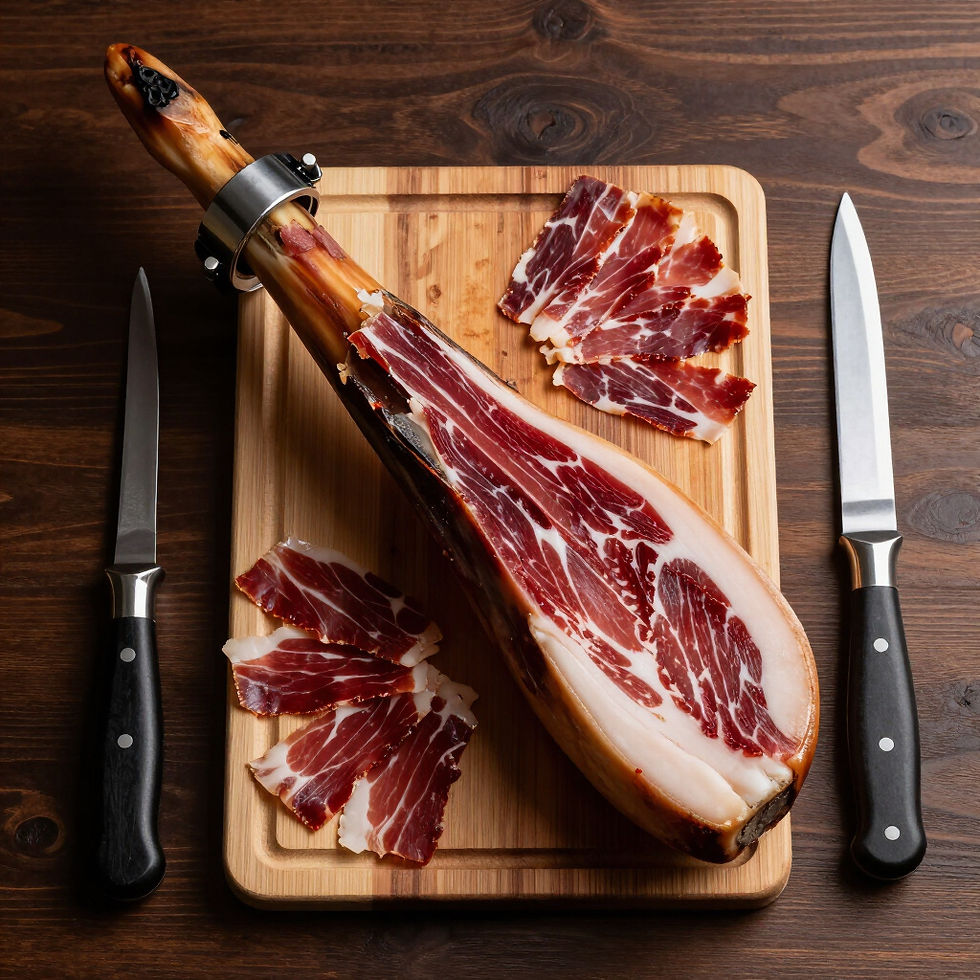
Understanding the net yield is critical for procurement efficiency. A standard 7.5kg bone-in whole leg typically delivers approximately 45% edible yield (~3.37kg of sliced meat), with the remainder composed of bone and external fat essential for the curing process. In contrast, Jamón bricks and boneless formats offer 100% usable yield, providing a streamlined solution for high-volume operations.
This technical breakdown directly answers common procurement queries such as "How much meat is in a Jamón Ibérico leg?" allowing chefs to conduct precise menu engineering and cost-per-plate calculations without the guesswork of natural variance.
Glossary of Exquisite Terms
Dehesa
A unique, sustainable agrosilvopastoral ecosystem in Spain where Ibérico pigs roam freely and forage on acorns during the Montanera season.
Pata Negra
The official designation for the highest tier of Ibérico ham, derived exclusively from 100% purebred Ibérico pigs fed a strict diet of acorns (Bellota).
Umami
The savory ‘fifth taste’ deeply present in Jamón Ibérico de Bellota, resulting from high levels of oleic acid and prolonged natural curing processes.